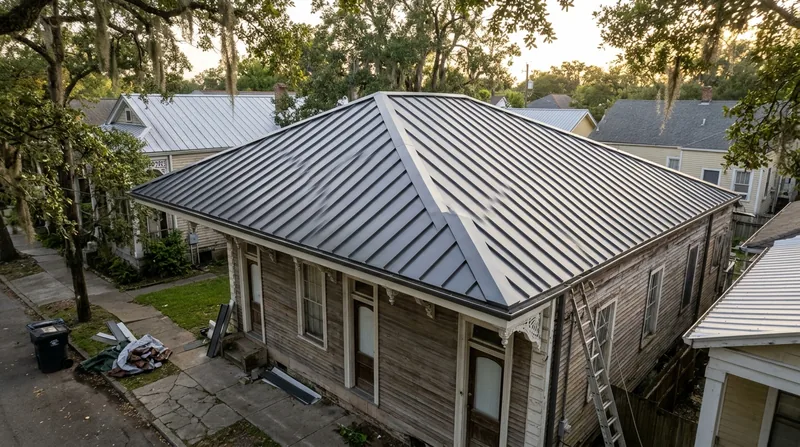




If you have spent any time on a roof in the Marigny or the Garden District, you know the light down here is different. So is the weather. Standing Seam Metal Roofing in New Orleans is the system we install most for homeowners who are done patching asphalt shingles after every named storm. The panels are roll-formed to the exact length of each roof run, then mechanically seamed or snap-locked, so there are no exposed screws to back out in a 90 mph gust off Lake Pontchartrain. On a raised center-hall home or a camelback with a long hipped roof, that continuous panel runs from ridge to eave in one piece. We work on Creole cottages, Greek Revival townhouses, shotgun doubles, and the newer elevated builds out in New Orleans East, and we match the panel profile and color to what the house and the historic district will allow. If you are comparing systems, start with our metal roof installation page for the full picture.
Why Standing Seam Holds Up to New Orleans Heat, Humidity, and Hurricane Wind
This city sits in a low, flat crescent between the river and the lake, often below sea level, under a subtropical climate that throws long soaking thunderstorms, tropical systems, and months of intense sun at every roof. The failure mode that dominates here is not snow load or freeze-thaw. It is wind-driven rain finding a fastener, and humidity feeding algae and mildew across a shaded north slope. Standing seam answers both.
- The concealed fastener design keeps screws under the panel, so there is nothing for storm wind to catch or back out.
- Mechanically seamed panels give superior uplift resistance compared with exposed-fastener systems on the same deck.
- The factory cool reflective finish cuts attic heat gain through the Gulf summer and helps the AC keep up.
- Long panel runs shed our heavy rain fast, with fewer seams for water to work into.
- Metal does not feed mildew the way organic shingle mats do, which matters in the shade of live oaks and magnolias.
For a house in Treme or the Irish Channel that has already been re-roofed twice, that combination usually ends the cycle of annual repairs.
Key info: On a raised bungalow in Carrollton with oak limbs over the ridge, we routinely find shingle tabs torn loose after a summer squall. A standing seam panel run takes that same limb strike without losing the field of the roof.
Roofing permits are commonly required for a full replacement or re-roof in this area, and thresholds vary by jurisdiction, so always confirm the current rules with the local building department before work starts. You can review the City of New Orleans permitting resources at nola.gov.
How We Install Standing Seam on a New Orleans Roof
Every job starts with the deck, not the panel. On these older homes we check the sheathing, the fascia, and the flashing details at chimneys and skylights before anything is ordered, because a premium panel over a soft deck is money wasted. Then we measure each run and roll-form the panels to length on site so there are no lap joints mid-slope.
- We inspect the deck, rafters, and existing flashing, and we document anything that needs correction first.
- We install the underlayment and the eave and rake trim to shed wind-driven rain at the edges.
- We roll-form panels to the measured length and set them in line across the roof plane.
- We mechanically seam or snap-lock the panels and fasten them with concealed clips.
- We detail the penetrations, then walk the roof and the gutters with you before we pull off site.
If your home is in the 70128 ZIP or out toward New Orleans East, you can see the local page for standing seam work in 70128 for the neighborhood specifics.
Key info: On a double shotgun in the Bywater, the two roof planes meet at different heights. We formed separate panel runs for each side and tied them at the party wall so the seam line reads clean from the street and the historic review board is satisfied.
Standing Seam Approaches We Use
The right system depends on the roof pitch, the span, the budget, and what the district will approve. These are the four approaches we install most often around New Orleans.
| Approach | Description | Best for |
|---|---|---|
| Mechanically seamed | Panels joined with a raised double-fold seam for maximum uplift resistance. | Exposed roofs on elevated and waterfront-adjacent homes. |
| Snap-lock | Concealed clips hold panels that snap together without a seaming tool. | Standard pitches on shotgun doubles and bungalows. |
| Standing seam over existing shingles | Retrofit with a subframe where the existing layer count allows. | Homes where tear-off cost and disruption are a concern. |
| Low-slope standing seam | Wider panels with tighter seam spacing for shallow pitches. | Post-war brick ranches in Lakeview and Gentilly. |
We confirm the profile and color against any historic district or HOA review before the panels are formed.
Standing Seam Metal Roofing Cost in New Orleans: What to Expect
Plan on a starting figure of From $10/sq ft for a standard standing seam install, and treat that as the floor, not the quote. Roof complexity is what moves the number: a simple gable on a slab ranch in Metairie prices differently from a hipped camelback with three valleys and a chimney to flash. Panel gauge, seam type, color, and the amount of deck repair all push the figure up or down.
- Roof pitch and the number of valleys, hips, and penetrations drive labor more than square footage does.
- Mechanically seamed panels cost more than snap-lock but carry better uplift numbers.
- Deck replacement on an 1890s Creole cottage adds scope that a visual estimate may miss.
- Historic district review can add time and limit the panel profile and color you can use.
Get two or three estimates on the same written scope, and ask each contractor to list the deck work and flashing separately. Our full pricing overview breaks down the components so you can compare bids line for line.
Standing Seam Metal Roofing Near Me: How to Vet a Contractor in New Orleans
When you search for standing seam metal roofing near me, the list you get is mostly ads. Here is how to sort the real installers from the storm chasers. Ask for the license and insurance certificate up front, get everything in writing, and call two past customers whose roofs are at least three years old.
- Confirm the contractor is licensed and insured, and ask for the certificate before signing.
- Get two or three written estimates on the same scope so the comparison is honest.
- Ask for references on standing seam jobs, not shingle jobs, and call them.
- Understand the permit and any historic district or HOA review that applies to your address.
- Check how they handle wind-driven rain details at valleys and penetrations, not just the field of the roof.
Reach out through our contact page to set up an on-site look at your roof.
Standing Seam Metal Roofing in New Orleans: Pricing Guide
| Service | Price | Details |
|---|---|---|
| Snap-lock standing seam, standard pitch | Starting at $10/sq ft | Includes underlayment, trim, and concealed clips on a sound deck; pitch and valleys move the price. |
| Mechanically seamed standing seam | Starting at $13/sq ft | Includes double-fold seaming and clips for higher uplift resistance; roof complexity and panel gauge move the number. |
| Standing seam over existing shingles | Starting at $11/sq ft | Includes subframe and trim where the existing layer count allows; deck condition and layer count drive the price. |
| Complex or large-scale roof | On estimate | Multiple valleys, chimneys, and historic district review need an on-site look before a number is given. |
| Travel | Included | In New Orleans and surrounding areas, no separate call-out or mileage fee. |
| Estimate | Free | Response within 24h at (504) 636-6074, no obligation to book. |
Indicative pricing, the exact cost depends on square footage, finish, and site access. Free personalized estimate within 24h at (504) 636-6074.


